
What Is the Killer App in Quantum Networking?

What Is a Killer App?
Basic Definition
A killer app, or killer application, refers to an innovative application that decisively drives the mass adoption of a specific technology or platform.
In other words, it is the decisive factor that makes people feel:
“Because of this one application, I must use this new hardware or system.”
Key Characteristics
It clearly proves the practical value of a technology.
A killer app becomes the representative use case that gives meaning to a new technology.
Examples include:
PC
Smartphone
AR / VR
Quantum computer
A classic example is VisiCalc.
VisiCalc, the spreadsheet program, became one of the decisive reasons why people needed personal computers such as the Apple II.
It creates a new market.
A killer app creates explosive demand in a field where there was previously little or no demand.
In other words, it turns an “interesting technology” into a “useful application” and creates a turning point for the industry.
It becomes the center of an ecosystem.
Once a killer app appears, related hardware, software, and services develop around it.
Representative Examples
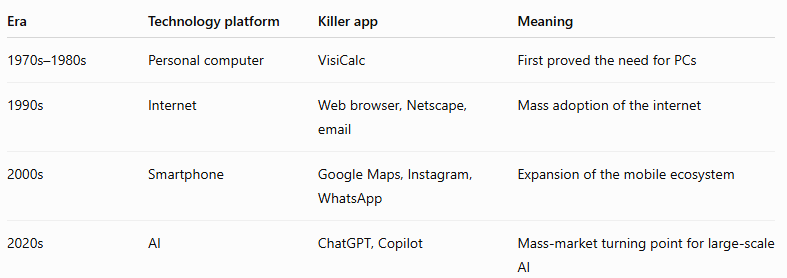
Expanded Definition in the Technology Industry
Recently, the term “killer app” has expanded beyond a single software program.
It is often used to describe the decisive application that allows a technology to become mainstream in an industrial or social sense.
Examples include:
Quantum-computing killer apps:
Drug discovery, optimization, materials simulation

Blockchain killer apps:
DeFi, NFT

AI-hardware killer apps:
Large language models
What Is the Killer App of Quantum Networks?
The killer app of quantum networks can be defined as an application that satisfies the following condition:
A service that uses quantum entanglement, quantum interference, or the no-cloning principle to perform functions that are impossible or extremely inefficient with classical networks.
In other words, the core is not simply faster communication.
The key is to provide a completely new paradigm of:
Trust
Security
Synchronization
Current Stage: 2020–2030 — Early Killer-App Candidates
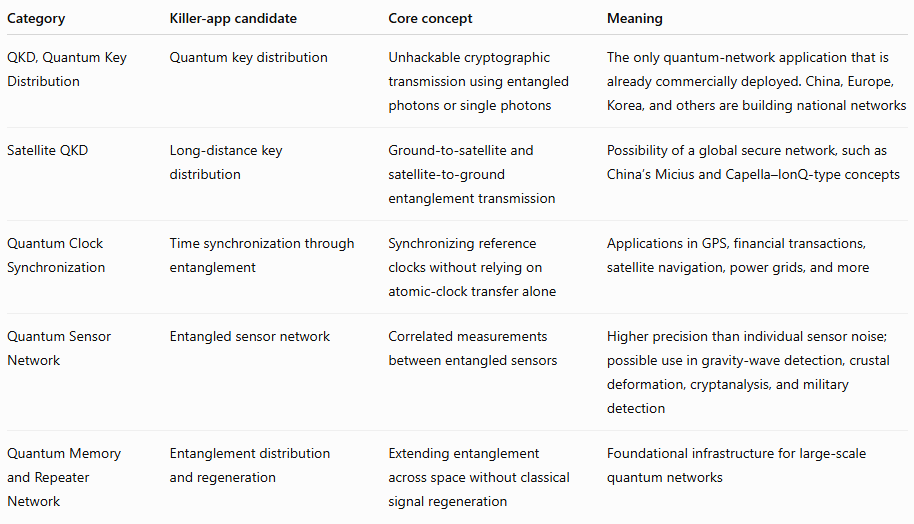
These are applications that replace or supplement the security and precision functions of the existing internet.
In that sense, they can be called the first-generation killer apps that prove why quantum networks are needed.
Mid-Term Stage: 2030–2040 — True Quantum Killer Apps
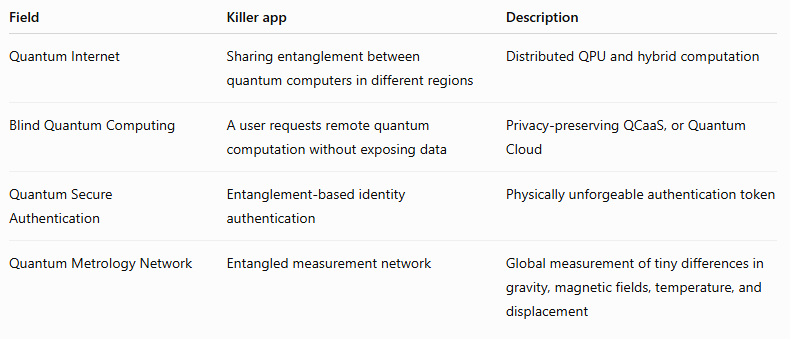
At this stage, quantum computers, sensors, and repeaters become integrated into one large entanglement network.
The quantum network then evolves beyond a simple “security channel” into infrastructure for exchanging quantum information itself.
Long-Term Stage: After 2040 — The Ultimate Killer-App Vision
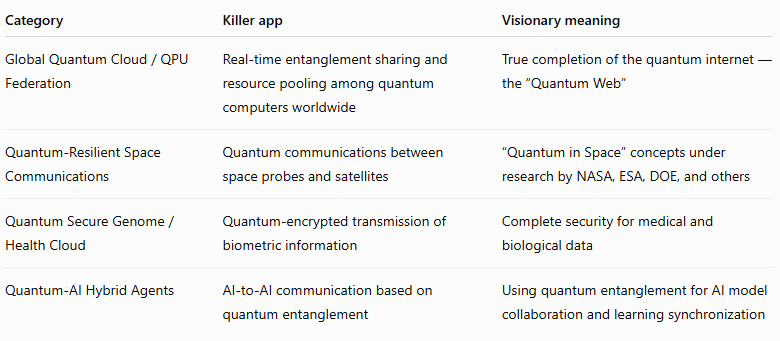
In this post, the killer-app effect at the current stage may still look relatively small from an industry-wide perspective.
However, quantum clock synchronization is still less widely understood, and its development path may be important.
PQC and QKD are also important, but awareness of those topics is already relatively high. They are also being prepared through government agencies such as NIST, standardization efforts, and early infrastructure buildout.
Quantum clock synchronization, however, is still less visible to the broader market, even though it was also discussed at Cisco Quantum Summit 2025.
That is why I want to look at it more deeply here.
Phase and Time of Light
Quantum Networks Exist on the Phase and Time of Light
All quantum networks transmit quantum information through photons, or light.
The transmission medium may be optical fiber, free space, or wireless channels. But the transmitted quantum object is ultimately light, and that light is used to create entanglement.
However, entanglement does not simply mean that two photons are “existentially connected.”
The phase and time of the two photons must match extremely precisely.
In other words, the quality of entanglement is determined by:
Fidelity
Time synchronization
Phase synchronization precision
If two photons differ by just 1 ns, interference may fail.
If the phase shifts by around π/100, the probability of a successful Bell-state measurement can collapse.
As a result, long-distance entanglement distribution or multi-node entanglement swapping can quickly break down due to accumulated time and phase errors.
Time Sync and Phase Sync Are the Lifeline of Entanglement
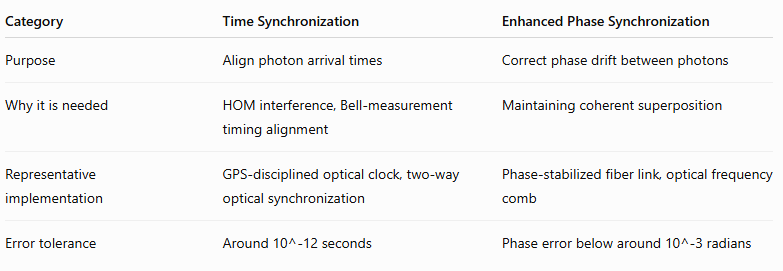
In other words, to successfully create entanglement or perform entanglement swapping, alignment precision at the nanosecond or even radian level is required.
If this cannot be achieved, several problems appear:
Entanglement success rate drops sharply
Entanglement fidelity falls, for example below 0.8
Multi-hop entanglement connection becomes impossible
A radian is a unit of angle defined by the ratio between arc length and radius.
1 rad ≈ 57.3 degrees
1 circle = 2π rad
It is used as a basic unit in differential equations, physics, and engineering calculations.
Why Does This Become a Killer App?
The reason is simple.
Time and phase synchronization are absolute standards that only quantum networks can provide.
First, if entanglement is used, precision beyond the limits of classical systems becomes possible.
Entangled photon pairs can provide time correlation that is tens of thousands of times higher than conventional synchronization systems, down to around the 10^-15 second level.
This becomes the foundation for a quantum clock network.
It can also lead to “quantum GPS,” or quantum positioning, which could be around 1,000 times more precise than today’s GPS.
Second, time and phase synchronization become the foundation for every network function.
Quantum repeaters, satellite links, and distributed QPU entanglement exchange cannot operate without time synchronization.
In particular, in multi-user quantum networks, without a shared phase reference, it is impossible even to distinguish “who is entangled with whom.”
Third, it can be applied directly as a commercial service.
This can move beyond a laboratory technology and become an operating business model.
Examples include:
Ultra-precision financial transaction timestamps
Quantum-enhanced GPS satellite-clock correction
Optical-clock synchronization between data centers
Circuit timing correction for distributed quantum computing
In other words, the real market value of quantum networks may not lie only in “creating entanglement.”
It lies in making entanglement maintainable.
Why Enhanced Phase Sync Is Technically More Important
What is even closer to the core than simple time synchronization is phase coherence.
For example, even across 100 km of optical fiber, temperature changes and vibration can cause the optical phase to drift by hundreds of radians.
That is why quantum-network research groups in each country are building phase-stabilized feedback loops.
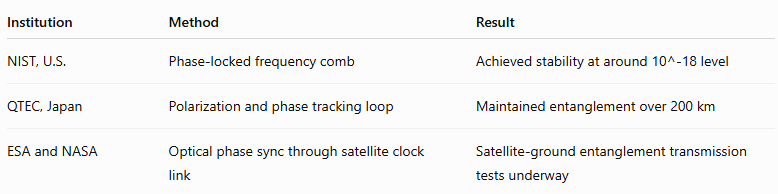
This phase-synchronized network can later be used not only in entanglement networks, but also in:
Atomic-clock networks
Quantum sensor networks
Distributed quantum-computing clusters
In other words, this can become infrastructure that feeds multiple industries.
That is why it can be called a killer app.
Summary: Why Time / Phase Sync Is a Killer App
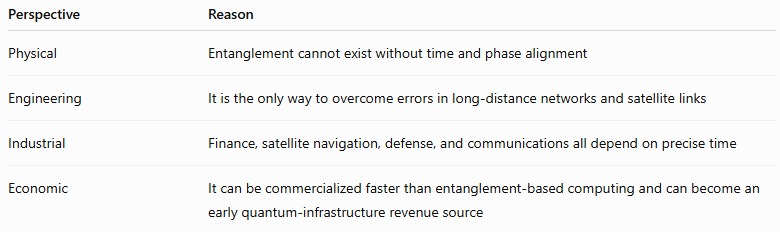
If entanglement is the heart, Time and Phase Sync are the arteries.
They are the rhythm that maintains and expands entanglement, and because they are the first practical technologies likely to be monetized, experts call them a killer app.
Which Comes First, the Chicken or the Egg?
The title is about the killer app of quantum networking.
One of those killer apps is time synchronization.
But to maintain a quantum network, time itself must be synchronized.
Time Sync Is More of a Tool
Entanglement generation is impossible without nanosecond-level photon-timing alignment.
Entanglement swapping is also difficult if the Bell-measurement timing between two intermediate nodes is off by even a few picoseconds.
In satellite links, the phase changes in real time depending on the satellite-ground Doppler shift and orbit movement.
Without phase tracking or loop phase lock, entanglement detection becomes impossible.
Therefore, Time and Phase Sync are not the final purpose.
They are a physical precondition for entanglement networking.
But the Tool Itself Becomes the Market
When experts call it a killer app, they mean it is the field that may first gain economic and industrial significance.
It refers to an area where independent demand can arise within the infrastructure layer of entanglement networks.
Time and phase synchronization fall exactly into that category.
Why?
Even if an entanglement network is not yet complete, precise time and phase can be used immediately in existing infrastructure.
But entanglement transmission or teleportation cannot be used without a completed network.
Time / Phase Sync is the tool of entanglement networking.
But in the real world, it may become the first quantum service that can be commercialized.
Examples in Real Industrial Structures
Commercialization examples include:
DARPA QNET / NIST QCS:
Provides phase-stabilized networks as a service-type time signal, or Quantum Timing-as-a-Service

BT and Toshiba QTEC, U.K.:
Launch of a quantum time-transfer service layered on top of QKD networks

ESA / Airbus / Leonardo:
Ongoing project to build a satellite-based Optical Time Distribution Network
→ Selling quantum-precision time services as an independent market, even without entanglement
Practical Examples of Time Synchronization
Why Is Precise Time So Important?
All digital networks operate on a shared clock.
In other words, each node must share the same time axis so that data, signals, financial transactions, GPS, and communications all align.
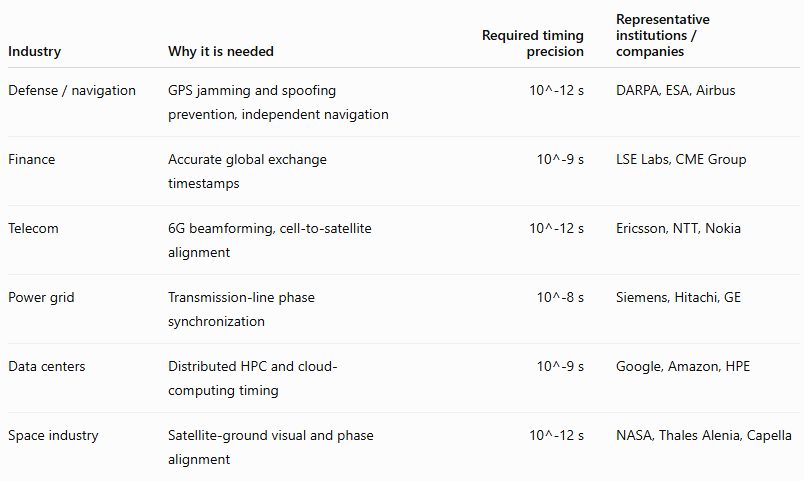
The problem is that existing GPS-based time synchronization does not reach the required precision in every environment.
The reasons include:
Atmospheric effects
Satellite path effects
Radio-wave interference
GPS jamming
GPS spoofing
Lack of GPS signal underground, underwater, or inside satellites
This is why experts view quantum time synchronization as the first practical application of quantum networks.
Jamming means blocking a signal by transmitting strong radio waves in the same frequency band, disabling the GPS receiver.
Spoofing means deceiving the receiver by transmitting a fake signal that looks like a real GPS satellite signal, causing the receiver to believe false time or position information.
Current Time-Synchronization Methods and Their Limits
Today, the time reference for most global infrastructure depends heavily on GPS signals or modified GPS signals.
Telecom base stations, financial servers, data centers, power plants, and defense systems all operate according to GPS time.
In other words, current systems are reducing error down to tens or hundreds of nanoseconds.
This is enough for ordinary GPS-based purposes.
But it does not satisfy the following conditions:
6G communications:
Satellite synchronization requires around 10^-12 seconds

Quantum entanglement:
Requires around 10^-15 seconds

Ultra-high-frequency trading:
Requires around 10^-9 seconds
Current Workarounds Using Non-Quantum Technologies
Atomic clock plus GPS correction
Data centers and telecom stations use GPS receivers together with rubidium or cesium atomic clocks.
Even if the GPS signal is lost, the internal clock can maintain the reference through holdover.
But even atomic clocks accumulate drift over hours or days, so they need correction again.
Multi-GNSS systems
Systems receive GPS, Galileo, GLONASS, and BeiDou together and average the error.
However, they still share the same electromagnetic vulnerability.
Jamming and spoofing are still possible.
Terrestrial synchronization, such as IEEE 1588 PTP
This attempts time synchronization based on packet round-trip time.
But if the network path becomes complex or congested, the error can grow to microseconds.
Cloud and 5G networks are already reaching their limits under this model.
Why Quantum Time Sync Can Become the Solution
Quantum-entanglement-based time transfer uses photons, not ordinary radio waves.
Because of that:
It is not affected by radio jamming.
It cannot be spoofed, because the entangled state cannot be copied.
It is physically verifiable through measurement correlation.
The precision is also overwhelming.
GPS:
Around 10^-9 seconds, nanosecond level

Optical two-way:
Around 10^-14 seconds

Quantum entangled sync:
Around 10^-16 to 10^-18 seconds
In other words, quantum time synchronization can solve both precision and security problems at the same time.
How to Synchronize Time Through Quantum Networks
Quantum time synchronization in a quantum network means physically aligning the clocks of two locations using entanglement or quantum interference.
Time-Synchronization Methods
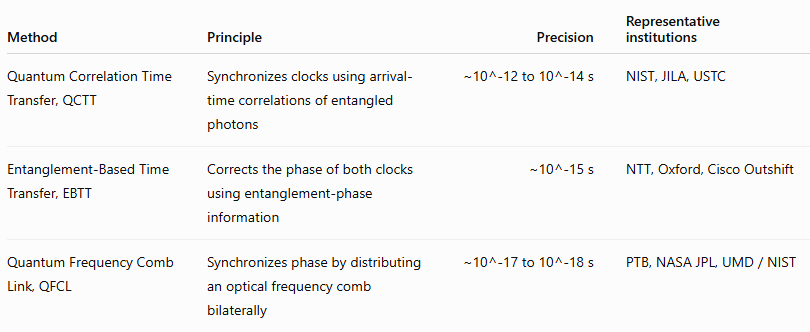
QCTT synchronizes clocks using entangled-photon click timing.
It is relatively simple.
EBTT synchronizes clocks using entanglement phase.
It is designed for entanglement networks.
QFCL synchronizes clocks by sharing optical frequency combs.
It is closer to the next generation of optical-clock networks.
The Most Intuitive Method: Entangled-Photon Pair Correlation
SPDC, or spontaneous parametric down-conversion, splits one pump photon into two entangled photons inside a nonlinear crystal.
Those two photons are born at the same time, so they carry a shared time reference.
Photon A and photon B are sent to two different locations.
Each location records the detector click time using its own local clock.
Then both sides exchange data and calculate the correlation.
By comparing the click timestamps of A and B, the relative clock offset between the two clocks can be estimated.
If Clock 2 is corrected by Δt, the two clocks become synchronized to the entanglement-generation time reference.
This differs from classical two-way signal exchange because the channel-delay error is canceled through quantum correlation.
In other words:
Path delay
Temperature change
Optical-fiber vibration
have almost no effect.
Time Synchronization at the Quantum-Network Level
If this principle is expanded and several nodes are connected, it becomes a Quantum Clock Network, or QCN, or a Quantum Timing Network, QTN.
The structure is:
Central node:
Master optical clock

Each regional node:
Slave clock

Link:
Entangled or phase-stabilized optical channel
The network periodically generates entanglement, and each node maintains a common time reference through phase correlation.
For example, in 2024, NIST–JILA–NRC synchronized two atomic clocks separated by 200 km using a quantum-correlation method, achieving around 10^-17 second precision.
Satellite-Based Quantum Time Synchronization, or Quantum GPS
A satellite can transmit entangled photons simultaneously to a ground station and a remote location.
The receivers directly compare quantum correlations and share a common time reference.
Unlike GPS, this does not require radio-wave delay correction between satellite and ground, and it cannot be spoofed or jammed.
Reference Clocks and Synchronization
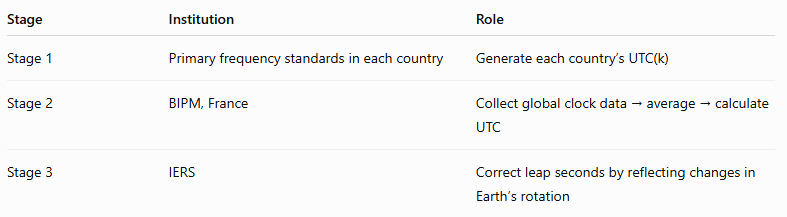
Today, the absolute standard for time synchronization is UTC, Coordinated Universal Time.
UTC is maintained jointly by national standards laboratories around the world.
Global Standard Time System: How UTC Is Created
Then What Is the “Real Reference Clock”?
Until now, cesium atomic clocks have been the international standard.
But as of 2025, optical atomic clocks are beginning to move toward the new standard.
In the future, a Quantum Clock Network, or QCN, may replace UTC.
The current UTC system is based on radio and GPS, so delay and distortion exist.
A QCN is based on entanglement and optical frequency combs, so synchronization is physical.
NASA, ESA, NIST, PTB, NPL, KRISS, and others are expected to become early nodes in such a network.
The current concept of each country comparing its own national standard clock and then BIPM calculating UTC may eventually disappear.
Instead, if the whole Earth is synchronized through entanglement at the comparison level, the entire planet becomes one massive entangled clock network.
“In the future, we won’t distribute time from one clock — we’ll become one clock.”
— David Wineland, NIST
Resources Needed for Quantum Time Synchronization
Equipment Actually Used
In quantum time-synchronization experiments or demonstrations, the following equipment is typically used.
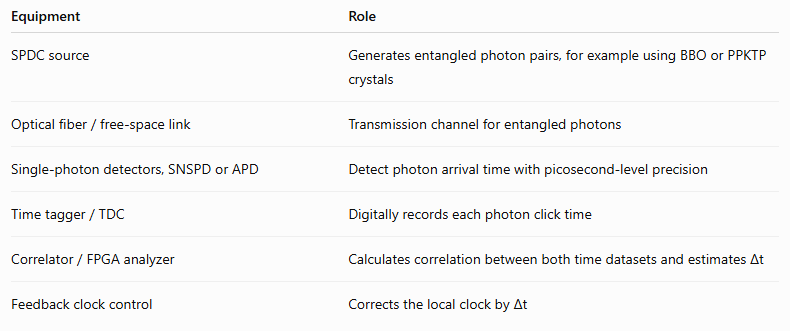
A quantum computer is not needed for quantum time synchronization.
Photon-communication equipment is needed.
In fact, this kind of quantum time system is the kind of quantum infrastructure that quantum computers themselves may need.
Areas Where IonQ Could Participate
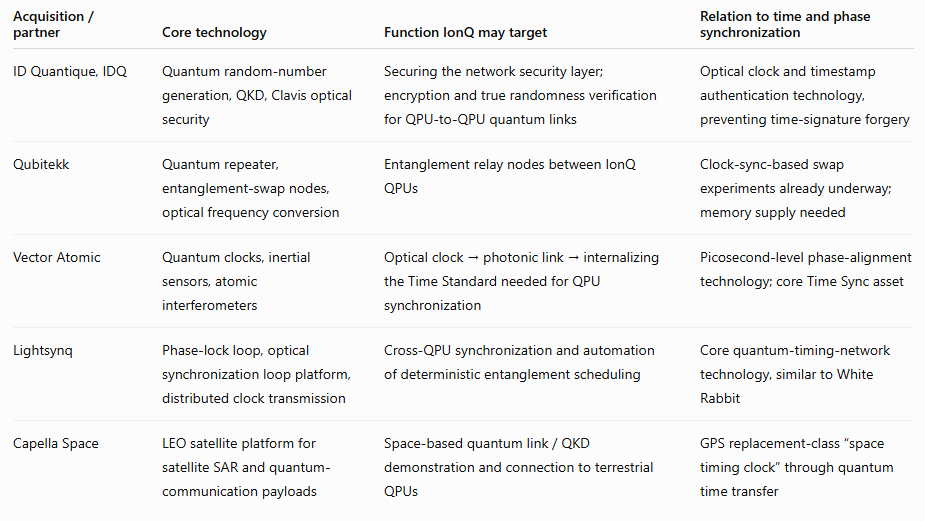
As a result, IonQ indirectly owns all layers of a quantum time-synchronization network.
Relationship Between IonQ’s Acquisitions and Time Synchronization
Vector Atomic → Time Source / Clock Origin
Vector Atomic has optical-clock and atomic-interferometer technologies.
Its precision is at the level of national standards laboratories, around 10^-15 seconds.
IonQ can use this as an internal clock reference layer, correcting entanglement-scheduling delay Δt at the picosecond level.
In other words, instead of directly importing time from institutions such as NIST, IonQ may create its own internal version of the reference.
Lightsynq → Clock Distribution / Phase Lock
Lightsynq can distribute clock signals across QPU modules and repeaters, maintaining phase coherence.
This is essential for solving cross-QPU gate-timing problems.
At this level, phase-based synchronization loops are tens of times more precise than White Rabbit or IEEE 1588.
Qubitekk → Quantum Repeater / Switch Layer
In entanglement-swap nodes, if the time offset Δt exceeds around 10 ps, gate fidelity drops sharply.
Therefore, Qubitekk may directly use timing-link signals provided by Lightsynq or Vector Atomic.
IDQ → Security / Verification Layer
IDQ has QKD, QRNG, and timestamp watermarking technologies.
It can guarantee digital signatures and integrity for data packets and entanglement metadata in IonQ’s distributed network.
This becomes a form of quantum authentication that proves the time information has not been forged.
Capella Space → Global Time Link / Entanglement Extension
Capella can transmit optical-clock signals or entangled photons from LEO satellites to ground stations.
Vector Atomic’s clock could connect through Capella satellites to IonQ terrestrial QPUs, completing a satellite-based timing loop.
In other words, Capella can play the role of:
Quantum GPS
+
Quantum network backbone
Time Synchronization Is the Foundation for Phase Synchronization
As discussed earlier, phase synchronization is even more important.
To transmit quantum information, the essential requirement is phase synchronization.
Why Is Phase Synchronization More “Killer-App-Class” Infrastructure?
Phase synchronization is not merely about accurately exchanging signals.
It is the key factor that determines:
Entanglement coherence time
Gate fidelity
Therefore, a company that completes phase synchronization may be able to expand into all three areas at once:
Distributed quantum computing
Quantum sensing, including OTQC
Satellite QKD networks
In short:
Phase Sync is the heart of every quantum network.
Components Needed to Achieve Phase Synchronization
Common Master Clock
All nodes must oscillate at the same frequency.
Ordinary electronic clocks such as OCXO or rubidium clocks are not enough.
An optical clock is required.
This is exactly where Vector Atomic, acquired by IonQ, fits.
Relevant requirements include:
Optical clock based on ultra-precision atomic interferometry
Stability around 10^-15
Ability to maintain phase error below picoseconds relative to MHz–GHz entanglement-gate frequencies
Frequency / Phase Distribution Network
The reference clock must be distributed equally to all QPUs, repeaters, and sensors.
But optical fiber constantly changes its length due to temperature, creating phase delay.
So a two-way transfer plus feedback loop is required.
Technologies that perform this role include:
White Rabbit
Lightsynq
Menlo Optical Sync-type systems
Lightsynq is developing a Phase-Locked Loop, or PLL-based network, that corrects picosecond-level phase differences in real time.
This enables cross-QPU entanglement synchronization for IonQ.
Optical Frequency Comb
To align phase perfectly, all frequency components must be spaced and aligned at constant intervals.
A frequency comb acts like an optical frequency ruler.
It can lock laser frequencies in the 10^14 Hz range with sub-picosecond precision.
It can also track the phase relationship between each photon pair absolutely.
NIST, Menlo Systems, and Thorlabs are commercializing this field.
The Vector Atomic plus Lightsynq direction suggests IonQ may be internalizing this area.
Phase-Locked Loop, PLL
Every node must monitor and correct not only frequency, but also vibration phase in real time.
Without PLL, while a photon travels over tens of kilometers of fiber, phase accumulates and entanglement is lost.
Lightsynq’s representative technology is exactly this picosecond-to-femtosecond-level PLL engine.
Mathematically:
Δφ(t) = ωΔt + noise(t)The goal is to keep:
Δφ(t) ≈ 0Thermal and Vibrational Isolation
Even a 1°C temperature change can shift the phase of optical fiber by picoseconds.
Therefore, environmental compensation equipment is needed across the network.
Examples include:
Vibration-absorbing modules
Temperature-controlled cables
Real-time optical delay compensation
IonQ may address this through Lightsynq modules and Capella’s satellite-ground link delay maps.
Calibration Algorithm and Real-Time Phase Feedback
Finally, hardware phase error must be corrected in software.
IonQ’s QOS may evolve into a quantum control hub.
It could attach phase metadata to each QPU, repeater, and link, and correct entanglement-generation and swap timing in real time.
Time sync means matching the clicks.
Phase sync means matching the rhythm of the quantum state.
For this, IonQ is building a structure involving Vector Atomic for the clock, Lightsynq for the phase loop, and Capella for link correction.
If this phase alignment is completed, entanglement transmission, sensing, communication, and distributed computation could operate inside one framework.
IonQ has vertically integrated quantum-networking technologies in order to implement remote entanglement between the quantum computers it develops.
However, this sequence of actions should be viewed not merely as infrastructure buildout, but as a strategic preparation process to realize the killer app of long-distance quantum networking.
This integrated approach is expected to become an important axis of IonQ’s future revenue structure.
As discussed earlier, it also shows a Japanese-style “two-way strategy,” similar to the matching of OTQC-based quantum sensing technology with trapped ions: strengthening both computing and sensing at the same time.