
QED-C’s Quantum Networking Roadmap

QED-C | Quantum Networking Applications Roadmap | QED-C
Quantum Networking Applications Roadmap May 2026
What Is QED-C?
QED-C stands for Quantum Economic Development Consortium.
It is a public-private industry consortium where the U.S. government, quantum companies, component suppliers, universities, national laboratories, and end users come together to identify bottlenecks and priorities for the quantum industry.
QED-C was created during the implementation of the National Quantum Initiative Act of 2018 through cooperation between NIST and SRI International. Since 2019, it has been operated by SRI International with support and participation from NIST.
According to QED-C’s official materials, around 250 organizations currently participate, including companies, universities, government agencies, and end users.
It Is Not a Government Agency
QED-C is not a government agency.
Its operating body is SRI International.
Its core government partner is NIST, which belongs to the U.S. Department of Commerce.
Its character is best understood as an industry-driven consortium.
Participants include companies, universities, national laboratories, federal agencies, and end users.
So QED-C is not an institution like DOE, DARPA, or AFRL that directly allocates budgets or awards contracts. It also does not directly create regulations or standards.
However, NIST directly participates in the QED-C Steering Committee, workshops, research activities, reports, and the Technical Advisory Committee.
NIST has officially described QED-C as a vital mechanism for supporting the U.S. quantum industry and communicating industry perspectives to the government.
What Does QED-C Do?
QED-C’s core role can be summarized in five areas.
1. Identify bottlenecks across the quantum industry
2. Communicate industry views to the U.S. government
3. Build the preconditions for standards
4. Connect roadmaps to actual research funding
5. Connect companies with end users
Policy Influence: High
QED-C is directly connected with NIST and submits joint industry perspectives to Congress and federal agencies.
Especially in areas such as quantum industry policy, government research funding, and national-security policy, QED-C can have meaningful influence.
However, QED-C does not make final government decisions.
Technology-Roadmap Influence: Very High
Around seven working groups participate in preparing reports, with input from companies, suppliers, universities, national laboratories, government agencies, and customers.
So when QED-C identifies a specific technology as a common bottleneck, the following groups are likely to pay attention:
NIST measurement and standards research
DOE and NSF research programs
National-lab testbeds
Venture investors and corporate technology strategies
Component suppliers’ product development
Government supply-chain policy
In this roadmap, the fact that optical switches, repeaters, and satellite infrastructure were selected as technologies enabling the broadest range of applications is a significant industrial signal.
Standardization Influence: High
QED-C itself is not a standards-publishing organization like ISO or NIST.
However, QED-C organizes technical requirements and use-case requirements.
NIST can then develop official measurement procedures and standardization work based on that input.
So QED-C is not the institution that directly writes the standard, but it sits at the front end of defining the direction and priorities of future standards.
Direct Funding Power: Medium to Low
QED-C itself does not execute hundreds of millions or billions of dollars in contracts like DOE or the Department of Defense.
Instead, because it is connected with a wide range of government information and industry participants, it plays a role in planning and connecting NIST-supported R&D programs.
In other words, its influence in defining the direction of government research funding may be more important than the size of its direct funding.
The 10 Applications Analyzed
The report divides quantum-networking applications into three major categories.
Network Security
1. Quantum Key Distribution, QKD
2. Blind Quantum Computing, BQC
3. Quantum-Secure Direct Communication, QSDC
4. Quantum Position Verification, QPV
5. Quantum Secret Sharing, QSS
6. Quantum Digital Signatures, QDS
Networked Quantum Computing
7. Clustered Quantum Computing, CQC
   A structure where multiple QPUs inside the same data center or campus are connected and used like one larger system
8. Distributed Quantum Computing, DQC
   A long-distance structure where quantum computers in different data centers or regions are connected through entanglement
Networked Quantum Sensing
9. Quantum-Enhanced Time Synchronization, QETS
10. Distributed Quantum Sensing, DQS
In other words, quantum networking is not simply a QKD communication network.
It is defined as common infrastructure connecting security, computing, and sensing.
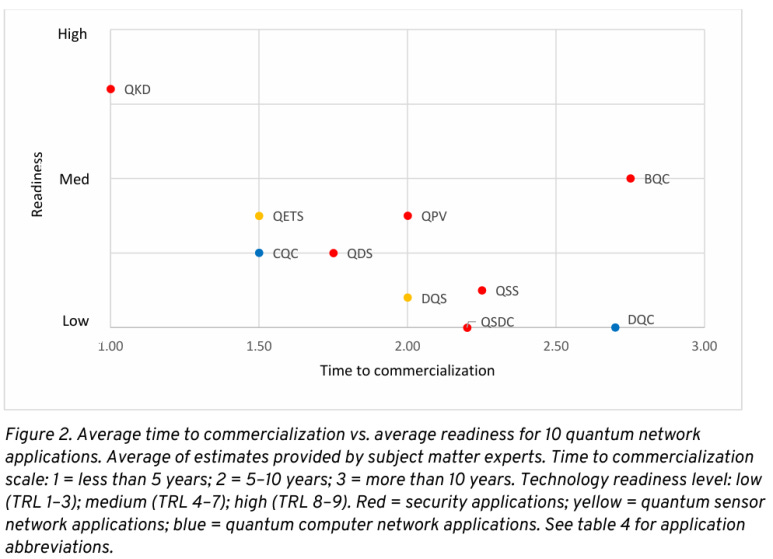
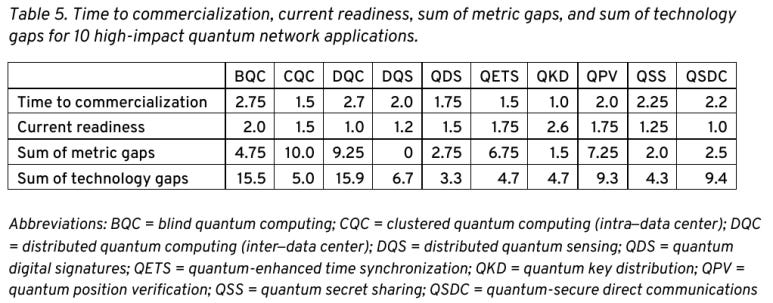
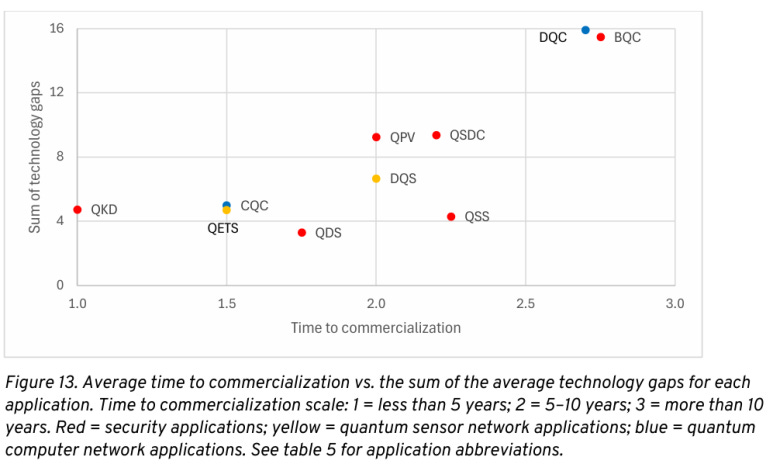
Expected Commercialization Order
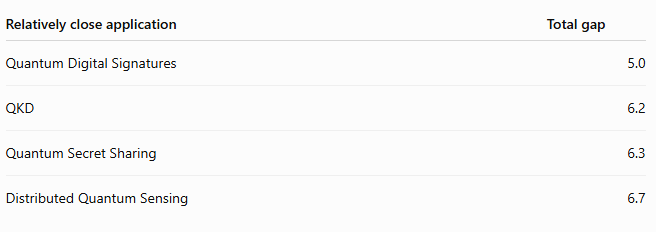
Applications That Are Relatively Close
The applications that appear relatively close to commercialization are:
QKD
Quantum Digital Signatures
Clustered Quantum Computing inside data centers
QKD and quantum digital signatures currently have relatively small gaps between today’s technology and final requirements.
Clustered quantum computing, which connects QPUs inside a data center, is presented as a roughly five-year-level commercialization opportunity.
The Most Distant Applications
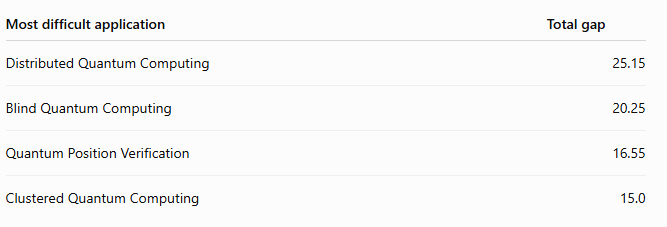
The most difficult applications are:
Long-distance Distributed Quantum Computing
Full implementation of Blind Quantum Computing
In particular, long-distance DQC, which connects quantum computers in different regions and operates them like one system, requires repeaters, memory, converters, switches, and synchronization technologies all at once.
The report suggests a long commercialization horizon of roughly 10 years.
Core Metrics for Evaluating Quantum Networks
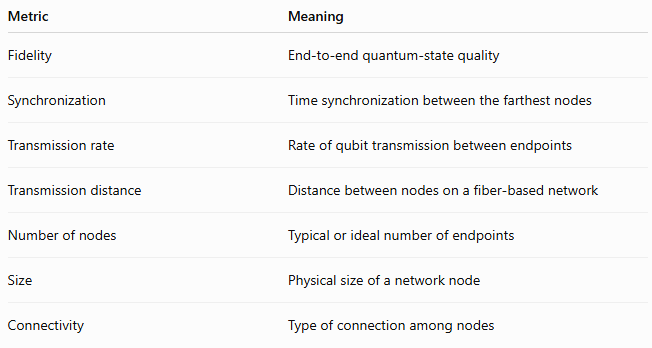
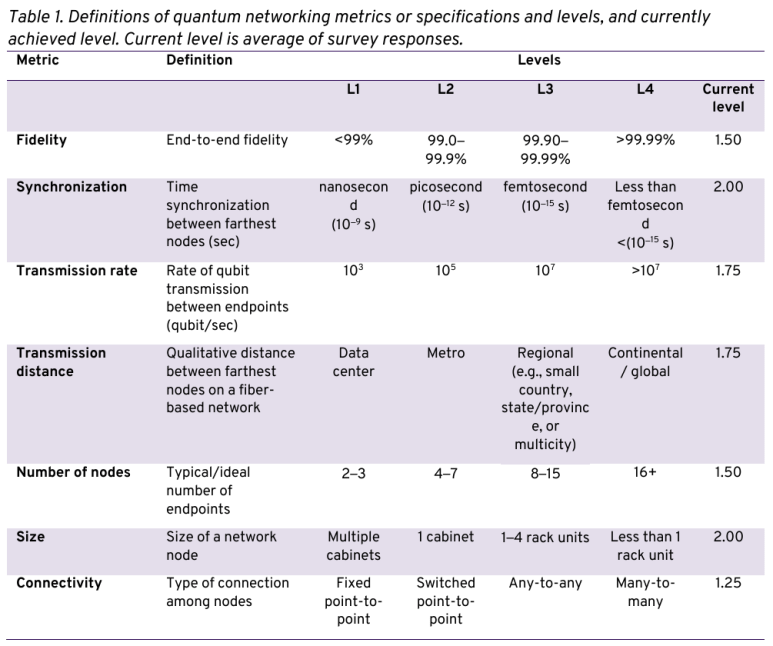
The report compares application requirements using seven quantum-network performance metrics.
Fidelity
Synchronization
Qubit transmission rate
Transmission distance
Number of network nodes
Network size
Connectivity
The items that require improvement across the largest number of applications are qubit transmission rate and transmission distance.
Each applies to 8 out of the 10 applications.
Fidelity and synchronization each apply to 7 out of the 10 applications.
This means the bottleneck of quantum networking is not simply “sending something farther.”
A useful quantum network must maintain enough speed, low loss, high fidelity, precise synchronization, and flexible network connectivity.
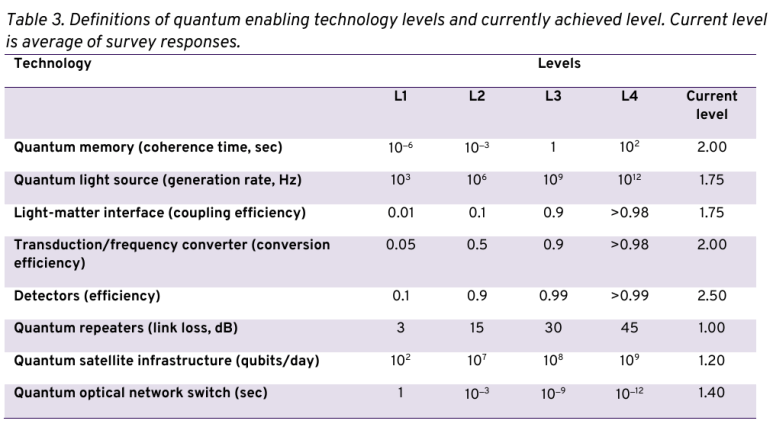
The Most Important Enabling Technologies
The report identifies the following as major enabling technologies.
Quantum memory
Quantum light sources
Light-matter interfaces
Transduction and frequency converters
Single-photon detectors
Quantum repeaters
Quantum satellite infrastructure
Quantum optical network switches
Among these, the technologies with the broadest ripple effect are:
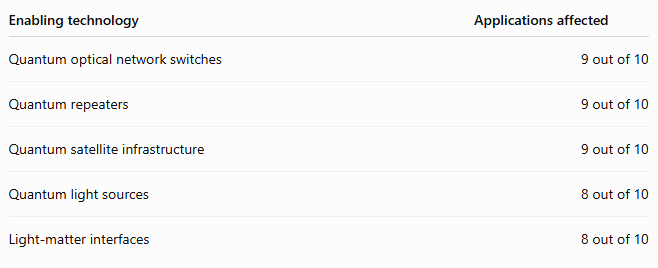
Therefore, the report’s most important conclusion is not that investors should choose only one quantum-network application.
The more important point is that investing in switches, repeaters, satellites, light sources, and interfaces that are commonly required across many applications may advance the entire ecosystem faster.
Surrounding Technologies Are Also Highly Important
In addition to the eight core quantum technologies, the report also presents several surrounding but essential technology layers.
WDM / DWDM low-loss optical components
Cryogenics
Photonic integrated circuits
Key management software
Network element management
Upper network management software
Compatibility with existing optical-fiber infrastructure
Precision time synchronization
Phase and channel stabilization
In particular, existing telecom ROADMs are generally not quantum-compatible.
Even if early quantum networks use existing single-mode metro or long-haul fiber, the management software and switching layers must be substantially changed.
What Is Possible Right Now Is Limited
With current technology, the applications that are partially possible today are essentially:
QKD
Distributed quantum sensing
But even these are mostly limited to short-distance, fixed, point-to-point connections.
A true quantum network — where multiple users dynamically connect, switches change routes, and repeaters extend distance — is still in an early stage.
For distributed quantum sensing, the bottleneck is not only the network itself.
It is also the maturity and commercialization of the sensors themselves.
Even if the network is ready, the market may not open immediately if atomic clocks, gravimeters, and magnetometers are still too expensive, unstable, or difficult to operate in the field.
Why Fiber, Satellites, and Switches Are All Needed
To build a broad quantum network, three elements are complementary.
Quantum repeaters:
Overcome optical-fiber loss and extend entanglement over long distances.

Quantum satellite infrastructure:
Provides long-distance and global quantum links.

Quantum-compatible optical switches:
Turns simple point-to-point links into shared multi-node and multi-user networks.
Therefore, satellites do not completely replace optical fiber.
Repeaters do not make satellites unnecessary.
The likely structure is:
Inside cities, data centers, and countries:
Fiber and repeaters

Across oceans and continents:
Satellites

Network operation:
Switches connect these pieces into an actual network
Meaning from an IonQ Investor’s Perspective
IonQ’s recent acquisitions are worth paying attention to from this perspective.
However, this report is not recommending any specific company.
It is identifying common technology bottlenecks across the industry.
From an IonQ investor’s perspective, the report connects to several important points.
First, QPU Scaling Eventually Moves Toward a Networking Problem
It is difficult to build a large-scale quantum system simply by increasing the number of physical qubits inside one chip, one ion trap, or one vacuum chamber.
Eventually, the system must first connect multiple QPUs inside the same data center or campus through clustered quantum computing.
After that, it can move toward long-distance distributed quantum computing.
The roadmap’s separation between CQC at around five years and long-distance DQC at around ten years suggests that short-range photonic interconnects may create economic value much earlier than the full long-distance quantum internet.
Second, IonQ’s Networking Acquisition Strategy Aligns with the Roadmap
IonQ’s acquired technologies overlap significantly with the enabling layers that the roadmap identifies as necessary across many applications.
These include:
Quantum networking
Light-matter interfaces
Frequency conversion
Photonic interconnects
Network orchestration
In particular, the logic that a platform capable of connecting quantum computers, sensors, and communication networks may have greater long-term value than a simple QKD business is consistent with the roadmap’s direction.
Third, Satellite Optical Communication and Quantum Satellites Are Not the Same
The roadmap emphasizes quantum satellite infrastructure, not ordinary high-speed OCT alone.
Therefore, even if a company has classical OCT technology like Skyloom, that does not automatically mean satellite QKD or satellite entanglement distribution is complete.
However, precise pointing, acquisition, and tracking, optical-link operation, satellite-network management, and classical control channels are still necessary foundations for quantum-satellite infrastructure.
To complete a full quantum-satellite system, additional technologies must be combined.
Entangled photon sources
Quantum memory
Detectors
Wavelength conversion
Core Message of the Report
The core message of this roadmap is the following:
The early market for quantum networks may begin with QKD and limited sensing, but the greatest long-term value lies in infrastructure that connects multiple QPUs and sensors.
Most applications today are still stuck in the point-to-point experimental stage.
For real quantum networks to emerge, transmission rate, distance, fidelity, and synchronization must improve.
In particular, the common bottlenecks are:
Quantum optical switches
Quantum repeaters
Quantum satellite infrastructure
From an investment perspective, this report is less about betting on one specific application and more about watching companies that own the bones and muscles of quantum networks that can be used repeatedly across many applications.
Those bones and muscles include:
Switches
Optical quantum memory
Light-matter interfaces
Frequency conversion
Alignment with IonQ
The roadmap’s eight key enabling technologies can be compared with IonQ’s portfolio as follows.
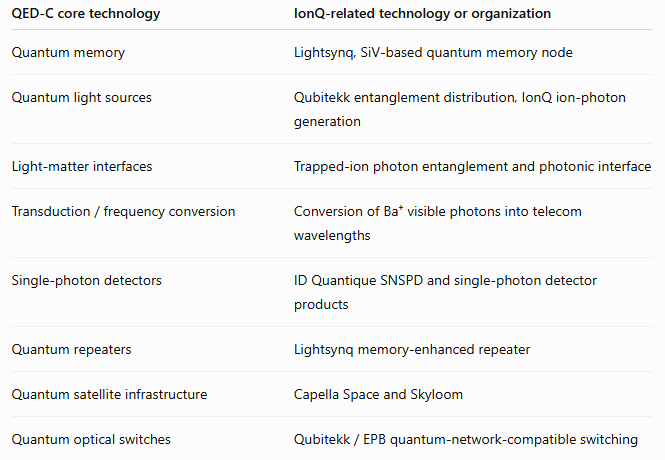
In other words, when looking only at publicly confirmed technology overlap, IonQ’s roadmap intersects with all eight core technologies highlighted by QED-C.
However, this does not mean IonQ has already achieved complete and dominant performance in all of these areas.
A more accurate interpretation is that IonQ has placed the required technology assets and research teams inside its portfolio.
Quantum Memory and Repeaters
Lightsynq brought quantum memory and repeater-related technology into IonQ.
IonQ has also announced plans to deploy its first SiV-based quantum memory node at the UMD QLab in 2026.
In the same year, it also said it had sold a quantum memory node to the Mid-Atlantic Regional Quantum Internet.
Light-Matter Interfaces and Photonic Interconnects
IonQ is working to entangle ion qubits with photons and has progressed toward connecting two independent ion systems through a photonic link.
In April 2026, IonQ announced that, with AFRL support, it had connected two commercial quantum systems through a photonic interconnect.
This is directly related to the roadmap’s clustered quantum computing and distributed quantum computing themes.
Frequency Conversion
Photons emitted from ions are not naturally optimized for long-distance commercial optical-fiber transmission.
IonQ and AFRL demonstrated a prototype that converts visible photons associated with Ba⁺ ions into telecom wavelengths.
This fits directly into the roadmap’s category of transduction and frequency conversion.
Detectors and QKD
Through ID Quantique, IonQ owns not only QKD systems, but also single-photon detector and SNSPD product capabilities.
This is not merely an additional security application.
It also gives IonQ access to the detection layer needed for quantum memory, repeaters, and entanglement distribution.
Switches and Real Optical-Fiber Testbeds
Qubitekk’s entanglement-distribution technology has been applied to EPB’s Bohr-IV Metro Quantum Network.
This gives IonQ an environment where researchers and companies can test quantum devices and applications in a real optical-fiber setting, rather than only in a laboratory.
Satellite Infrastructure and Free-Space Links
Capella provides satellite platforms and operational infrastructure.
Skyloom provides space-to-ground and space-to-space optical-link technology.
IonQ has officially stated that Capella could support space-based QKD network development.
Through Skyloom, IonQ added free-space optical communications and photonic-systems engineering capability.
Separately, under AFRL-related work, research is also being conducted on free-space optical links between the ground and drones.
Precision Synchronization and Distributed Sensing
Vector Atomic owns atomic clocks, synchronization hardware, gravimeters, and inertial sensors.
Therefore, IonQ now also has a technical base related to quantum-enhanced time synchronization and distributed quantum sensing.
However, this does not mean a complete distributed quantum-sensing network has already been built.
Application Areas Also Overlap Significantly
Among the 10 applications in the roadmap, the areas where IonQ is already researching or commercializing technologies include:
QKD:
ID Quantique, Qubitekk, and national / city quantum networks

Blind Quantum Computing:
ARLIS contract

Clustered Quantum Computing:
Multi-QPU scaling through photonic interconnects

Distributed Quantum Computing:
AFRL and DARPA HARQ

Quantum-Enhanced Time Synchronization:
Vector Atomic

Distributed Quantum Sensing:
Future integration area involving sensors, networks, and space infrastructure
IonQ carried out a contract with ARLIS to design a blind quantum-computing network.
In DARPA HARQ, the program studies heterogeneous network architectures that connect different quantum computers — ion traps, neutral atoms, superconducting qubits, and others — through high-speed interconnects.
On the other hand, for QSDC, quantum position verification, quantum secret sharing, and quantum digital signatures, even if IonQ owns related underlying technologies, it is not appropriate to conclude from public information alone that IonQ is running separate major products or research programs in all of those areas.
The More Important Interpretation
It would be too narrow to interpret this roadmap as:
“IonQ participated in the roadmap, so the roadmap was written favorably for IonQ.”
Only some IonQ-related people appear among the participants, such as Duncan Earl, Tim Rogers, and Jordan Shapiro.
The rest of the participants include competitors, telecom-equipment companies, defense organizations, government agencies, universities, and national laboratories.
The important point is not that IonQ influenced the roadmap.
The important point is that the common bottlenecks selected by this independent industry ecosystem overlap strongly with the technologies IonQ has been acquiring and developing over the past few years.
In other words:
This is not a roadmap created to explain IonQ.
It is a roadmap created by an independent industry ecosystem that happens to identify many of the same technology ingredients IonQ has been collecting.
In particular, QED-C highlighted quantum optical switches, repeaters, and satellite infrastructure as enabling technologies for the largest number of applications.
IonQ has entered all of these areas through Qubitekk, Lightsynq, Capella, and Skyloom.
Investor Conclusion
This report does not prove that IonQ will succeed.
Owning components and integrating them into one stable and economically useful network are completely different things.
The following still need to be validated:
Acquisition integration
Technology maturity
Loss rate
Transmission speed
Fidelity
Cost
Customer demand
However, at minimum, the following points are clear.
IonQ’s quantum-networking acquisitions were not random purchases.
The QED-C roadmap describes the next-generation quantum-network stack as something that must be vertically assembled from:
Memory
Detectors
Switches
Repeaters
QPU interfaces
Precision clocks
Terrestrial networks
Satellites
So this document is better understood not as direct proof of IonQ’s technology, but as a strategic validation document from the external ecosystem explaining why IonQ needed Qubitekk, ID Quantique, Lightsynq, Capella, Skyloom, and Vector Atomic.
Reference: Participant List
Why L3Harris Was Included
L3Harris is a major aerospace, defense, and space company.
But it is not just a simple satellite manufacturer.
It is an integrated defense-technology company that works across sensors, communications, ISR, electronic warfare, and mission systems.
In particular, committee member Timothy C. Burt is L3Harris’s Quantum Networking Lead Scientist.
L3Harris is officially conducting research on applying quantum sensing and quantum networking to aerospace, space, and defense mission systems.
The report evaluated current satellite infrastructure as one of the three technologies capable of enabling 9 out of the 10 applications.
Therefore, L3Harris’s participation should not be understood simply as “a large company being included.”
It represents the following areas:
Satellite-based entanglement and QKD distribution
Free-space optical links
Space-based quantum sensor networks
Defense quantum sensing and secure communications
Space-ground hybrid networks
In other words, the fact that L3Harris participated is strong evidence that the report considers not only terrestrial optical-fiber quantum networks, but also space quantum networks.
Criteria for Participant Recognition
Here, “recognition” does not mean general public awareness.
It means recognition inside the quantum-networking, quantum-optics, and U.S. quantum-policy ecosystem.
S level:
Global authority who created or shaped the direction of the field

A level:
Major figure leading national programs, large research centers, or industry

B level:
Recognized specialist in a specific technology or industrial domain

C level:
Practitioner, policy, or business expert with more limited public research visibility
Low recognition does not mean low expertise.
Especially in the case of NSF and DOE officials, influence over research funding and program direction may be more important than academic paper recognition.
Roadmap Committee
Tim Burt — L3Harris
Rating: A-
He is a defense and aerospace quantum-networking expert.
He is L3Harris’s Quantum Networking Lead Scientist and also participates in the industrial advisory side of the NSF Center for Quantum Networks.
His importance is less about being a globally famous academic and more about being an industry expert who understands how to place quantum technology into real aerospace and defense systems.
Duncan Earl — IonQ
Rating: A
He is one of the original industrial figures in U.S. practical quantum networking.
He was a co-founder of Qubitekk and previously worked as a researcher at ORNL.
He has experience with commercial quantum networks such as EPB, tactical QKD, entangled-photon sources, and networked quantum applications.
IonQ introduced him as a nationally recognized pioneer in practical quantum applications.
In terms of pure academic fame, he may rank below people such as Saikat Guha or Paul Kwiat.
But in terms of experience building real optical-fiber quantum networks in the U.S., he is a core figure.
Elliott Mason — Young Basile
Rating: B+
He is an expert in quantum communications, patents, and standards.
He received his PhD from MIT and participated in research on long-distance quantum teleportation-based technologies.
He now works as a patent specialist and leads QED-C quantum-networking standards activities.
He represents the perspective of IP, standardization, and industrial transfer rather than only basic research.
Kirk McGregor — If Technologies
Rating: C+
He is a quantum-application and business-strategy expert.
He has project experience applying quantum computing to biotechnology and drug discovery.
However, his public recognition as a core quantum-networking researcher appears relatively lower.
His role in the committee seems to reflect the application and commercialization side.
Celia Merzbacher — SRI / QED-C
Rating: A+
She is one of the highest-level figures in U.S. quantum-industry policy and ecosystem coordination.
She is the Executive Director of QED-C and has experience with OSTP and PCAST.
She is not a quantum-networking researcher, but her importance lies in the policy authority and industry representativeness she gives to the report.
Alireza Shabani — University of Arizona / CQN
Rating: A
He is a core figure in quantum-network architecture.
He has experience with Google Quantum AI and the establishment of Cisco Quantum Lab.
His research includes packet-switched quantum networks, entanglement routing, and satellite-constellation-based quantum internet.
He appears to be one of the technical centers of gravity of this roadmap.
In particular, when connected with L3Harris, his background in global quantum internet architectures using satellite optical links becomes important.
Mark H. Mortensen — Report Author
Rating: B
He is a telecom and systems-analysis expert.
He has more than 40 years of experience in OSS / BSS, network operations, telecom software, and system architecture.
He is not a quantum-optics researcher, but he is well positioned to organize quantum-network research into telecom architecture and commercial requirements.
The Most Globally Recognized Researchers
Saikat Guha — University of Arizona
Rating: S
In this participant list, he is one of the most important figures in quantum networking itself.
He is the Director of the NSF Center for Quantum Networks and leads the roughly $50 million CQN program over 10 years.
He is a global authority across quantum communication limits, repeaters, routing, and sensing.
Paul Kwiat — University of Illinois
Rating: S
He is a foundational figure in entangled photon sources, hyperentanglement, and optical quantum information.
Among photon-based quantum communication and quantum-networking researchers, he is extremely well known.
Don Towsley — UMass Amherst
Rating: S
He is a global authority in internet networking.
More recently, he has become a leading theorist in quantum-network routing, resource allocation, and performance modeling.
He is one of the few top-level researchers capable of connecting classical internet theory with the quantum internet.
Edo Waks — University of Maryland
Rating: A+
He is a world-class researcher in quantum dots, nanophotonics, quantum frequency conversion, quantum memories, and network nodes.
He is connected to UMD’s quantum-technology ecosystem and has also conducted wavelength-conversion research important for ion-trap quantum networks.
This group alone gives the report considerable academic weight.
Major A-Level Figures
Nicholas “Nick” Peters — Oak Ridge National Laboratory
Rating: A+
He is a key DOE figure in quantum communications and has led ORNL’s quantum information science efforts.
He has been deeply involved not only in laboratory research, but also in tactical QKD and field quantum-network demonstrations.
Thomas Gerrits — NIST
Rating: A
He is a leading figure in SNSPDs, single-photon detectors, quantum optical metrology, and performance evaluation of quantum-network components.
He is especially important in measuring and standardizing the performance of future quantum-network equipment.
Michael Hayduk — AFRL
Rating: A, based on government and defense influence
He manages large-scale organizations and budgets inside AFRL’s Information Directorate and has coordinated AFRL’s quantum information science portfolio.
He is not simply a paper-style researcher.
He is an influential figure in deciding which quantum technologies the U.S. Air Force invests in.
Joe Fitzsimons — Horizon Quantum
Rating: A
He is a co-founder of blind quantum computing and the founder of Horizon Quantum.
He is directly relevant to the BQC requirements section of this report.
Mehdi Namazi — Qunnect
Rating: A-
He is a co-founder and CSO of Qunnect.
He has developed room-temperature quantum memory and field-deployable quantum-network equipment.
He is one of the representative industrial researchers implementing quantum memories and entanglement distribution in real optical-fiber infrastructure.
Pavel Lugovskyi — DOE / ORNL Group
Rating: A-
In the participant list, his name is shown as Pavel Lugovskyi, though he is often known as Pavel Lougovski.
He is a well-known DOE researcher involved in quantum information, quantum communications, and quantum networks centered around ORNL.
Ryan Camacho — Brigham Young University
Rating: A- / B+
He is known for integrated quantum photonics and silicon-photonics-related research for QKD and CQN components.
He is one of the key academic researchers in the CQN ecosystem.
Brian J. Smith — University of Oregon
Rating: A- / B+
He is a strong researcher in quantum optics, photon sources, and quantum information, and leads quantum-optics and quantum-science research at Oregon.
Silvia Zorzetti — Fermilab
Rating: A-
She is connected with Fermilab’s Quantum Communication and Co-Design efforts, and is also involved in the SQMS quantum-communication ecosystem.
Farzam Toudeh-Fallah — Ciena
Rating: A-, based on telecom-industry criteria
He is responsible for Ciena’s Quantum Communications R&D.
He is a real telecom-operator-network integration expert studying how QKD can coexist with existing DWDM and 800Gbps-class optical networks.
B-Level Figures: Researchers and Industry Figures with Strong Expertise
Mark Beck — NSF
Rating: B+
He is an NSF figure with a background in quantum optics research and influence over research programs.
Mark Byrd — NSF
Rating: B+
He is known in quantum information, error correction, and quantum control, and has influence over NSF program direction.
Alexander Cronin — NSF
Rating: B+
He is known in atom interferometry and quantum optics.
He is especially relevant to quantum sensing and distributed sensing evaluation.
Michael Cubeddu — Aliro Quantum
Rating: B+
He is a quantum-network industry expert involved in Aliro Quantum’s technology and product development.
He represents enterprise demand for QKD and entanglement-based networks.
John Jarman — Nu Quantum
Rating: B+
He is Nu Quantum’s International Tech Lead and an industry expert in entanglement fabric and clustered quantum computing for data-center QPUs.
Julian Martinez-Rincon — Brookhaven National Laboratory
Rating: B
He is a national-lab experimental researcher connected to quantum sensing and networking.
He may be less publicly famous than global stars, but he works in a specialized area relevant to the report.
Narayanan Rengaswamy — University of Arizona
Rating: B+
He is a relatively young researcher in quantum error correction, quantum information theory, and network protocols.
He appears likely to grow further given the current trajectory.
Rima Oueid — Department of Energy
Rating: B+ / A-, based on government influence
She is influential in the connection between quantum-industry policy, DOE programs, and technology commercialization.
Her importance is less about pure research recognition and more about designing federal programs and connecting government with industry.
Wil Oxford — Anametric
Rating: B
He is a founder and industry expert in semiconductor security and quantum cybersecurity.
His contribution appears centered on network security and commercialization perspectives.
Edward Parker — RAND
Rating: B+
He is a RAND researcher analyzing national-security, policy, and economic dimensions of quantum technology.
His expertise is less about the technology itself and more about how the U.S. government evaluates and invests in quantum networks.
Hari Paudel — NETL
Rating: B
He is a government researcher studying the intersection of energy infrastructure and quantum-information technology.
He has expertise from the perspective of energy-network and sensing applications.
Alejandro Rodriguez — NASA
Rating: B+
He represents NASA’s interest in space communications and quantum communications.
His participation, together with L3Harris, may be connected to the possibility that satellite quantum-infrastructure requirements were realistically reflected.
John Paul Sawyer — University of Maryland
Rating: B
He is a specialist involved in CQN and UMD quantum-network research and testbed activities.
He may not be widely known publicly, but his practical relevance is high.
Shijia Zhao — Argonne National Laboratory
Rating: B
He is a next-generation researcher working on quantum networking and photon distribution at Argonne.
He has significance from the perspective of national-lab demonstrations and network operation.
David Wade — EPB Quantum
Rating: B+, based on commercial deployment criteria
He is not a physicist, but he is the operator of one of the first commercial quantum-network-as-a-service infrastructures in the U.S.
He represents the practical question of how to build and sell a quantum network that customers can actually use.
Jordan Shapiro — IonQ
Rating: B+ / A-, based on business strategy
He is not an academic researcher, but he led IonQ’s quantum-networking business and the acquisition strategy involving Qubitekk and ID Quantique.
His influence is stronger in capital allocation, M&A, and commercialization than in technical papers.
Tim Rogers — IonQ
Rating: B
As a Quantum Solutions Engineer, he has worked on network scalability, interoperability, and real customer applications.
He is less a research leader and more a practitioner who reflects product and customer requirements into the roadmap.
Jonathan Ruane — MIT
Rating: B
He participates in MIT Quantum Index and analysis of industrial data and technology trends.
He is better understood as an industry, market, and policy analyst than as a core quantum-optics researcher.